

If you’re reading this, chances are your little one is around 3–5 months old, and you’ve either heard whispers about—or are living through—the 4-month sleep regression.
Here’s the truth: it’s not a regression at all. It’s a progression. Your baby’s sleep is maturing in a big way.
Around four months, your baby’s sleep matures significantly. At around four months, your baby’s Circadian Rhythm begins shifting into a more adult-like sleep pattern. They now move between REM (dream) sleep and non-REM (deep) sleep in cycles. At the end of each cycle your baby naturally wakes just like adults do.
The difference? Adults know how to roll over and go back to sleep. Babies often don’t—especially if the way they fell asleep at bedtime (rocking, feeding, holding) doesn’t match what they experience when they wake between cycles.
This is why so many parents suddenly find themselves resettling their baby multiple times a night.

Imagine you fall asleep in your cozy bed but wake up on the dining room floor. You wouldn’t just drift back to sleep—you’d feel unsettled and call out for help.
That’s exactly how your baby feels if they’re transferred asleep into their cot after being rocked or fed. When they wake, the environment has changed. They cry for you to recreate the original conditions that they fell asleep.

The goal isn’t to force independence but to create predictability and familiarity so your baby feels safe falling back asleep on their own. Here’s how you can start:
Use the 5 Routine Foundations (Anchors, Nutrition, Awake Time, Connection/Transitions, Sleep Foundations) to guide your day.
Introduce a calm, consistent bedtime routine your baby comes to expect.
Support your baby to settle in their cot—not fully asleep, but comfortable and calm.
Gradually reduce dependence on external aids like rocking or feeding to sleep.
These small, gentle shifts help your baby connect sleep cycles without needing you every 2 hours.
If you’re already experienceing and exhausted by frequent wake-ups, my Lullababy SOS programs will help you:
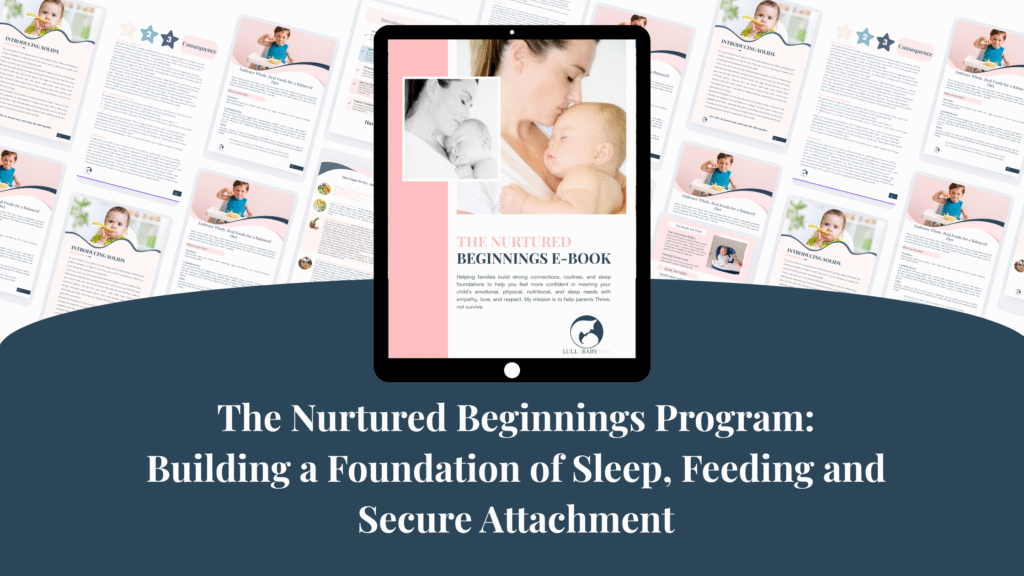
The Nurtured Beginnings Program is designed to help parents from birth build strong foundations for sleep, nutrition, connection and routine. By creating consistent daily rhythms and positive associations, babies learn what to expect and how to feel secure in their crib
Inside the program you’ll find:
Daily flow examples for predictable structure.
Gentle, attachment-based settling techniques.
Tools to gradually reduce reliance on external aids.
Guidance to help babies self-settle and link sleep cycles naturally.
These foundations mean fewer night wakings, calmer bedtimes, and more rest for the whole family.
You baby learns what you teach and what you do most consistently becomes habit and so creating positive associations around predictable repeatable activities and teaching gentle, attachment-based settling techniques from birth. This program emphasizes:
By guiding your baby toward self-settling early on, The Nurtured Beginnings Program helps your baby naturally link sleep cycles independently, significantly reducing frequent nightly wake-ups.
Remember, this phase is a natural step toward better sleep. With patience and gentle guidance, restful nights will return.

At around 4 months, your baby’s sleep matures into cycles of light (REM) and deep (non-REM) sleep. Each cycle lasts about 2 hours. When they wake at the end of a cycle, they often need help to fall back asleep—especially if they were rocked, fed, or held to sleep at bedtime.
Most babies experience disrupted sleep for 2–6 weeks. The length depends on how quickly your baby learns to link sleep cycles and feel secure in their cot. Gentle, consistent routines help shorten this phase.
Yes. It’s a developmental stage, not a random setback. Every baby’s sleep matures at this age, but how noticeable it feels varies depending on sleep habits and routines already in place.
At this age, babies still need night feeds. But if your baby was sleeping longer stretches and is now waking every 2 hours all night, it’s very likely due to sleep associations rather than genuine hunger.
I know, I know it’s hard to hear in the moment that the resolution to the problem is making big changes to what you’re currently doing is the key to resolving the problem, but external associations that you need to implement at bedtime are what your baby is going to seek out overnight. Until these changes are made, you are likely to continue to have broken sleep
Support your baby to settle in their cot instead of fully asleep in your arms.
Use gentle support to reduce reliance on rocking or feeding to sleep.
Focus on daytime rhythms that
Every baby is unique, and progress depends on temperament, feeding needs, and sleep foundations. All babies will rouse at night, even ones that we classify as “Sleeping through the night”, but your baby will only sleep through the night independently once they have a solid routine foundation, good nutrition throughout the day and feel comfortable in their sleep space and overall routine. Many babies achieve this around 6–9 months with consistent routines.
The 4-month sleep regression is a permanent developmental shift in how your baby's sleep architecture works. Around 3.5 to 5 months, babies transition from newborn sleep cycles to more adult-like sleep cycles, meaning they now experience lighter sleep between cycles. This is a neurological maturation, not a setback — and it does not reverse.
For most families, the acute disruption lasts two to six weeks. However, if a baby develops reliance on a sleep association (being fed, rocked, or held to sleep) during this period, the waking can continue indefinitely until the association is gently addressed. The regression itself ends — the habit waking may not without support.
The most effective strategies include establishing a consistent, age-appropriate awake window before sleep (typically 1.5–2 hours at this age), ensuring the sleep environment supports sleep (darkness, white noise), offering a predictable pre-sleep wind-down routine, and gradually supporting your baby to settle with less parental intervention over time — without leaving them to cry alone.
No. At 4 months, babies are in a critical period of attachment formation. Leaving a baby to cry unattended can elevate cortisol levels and undermine the sense of security that supports healthy sleep long-term. Gentle settling approaches that support co-regulation are both more effective and developmentally appropriate at this age.
No, though they can overlap. A growth spurt typically lasts three to five days and involves increased hunger. The 4-month regression is a permanent neurological change. If your baby is waking more than usual and feeding hungrily every time, a growth spurt may be contributing — but the underlying change to sleep architecture remains regardless.

If sleep, routines, toddler transitions or starting solids have felt a little overwhelming lately, this is a good time to get support. For a limited time, all Lullababy SOS Guides, Programs and Sleep Tools are 30% off. Sale applies to shop products only. Consultations excluded. Use code: EOS30 in store now